
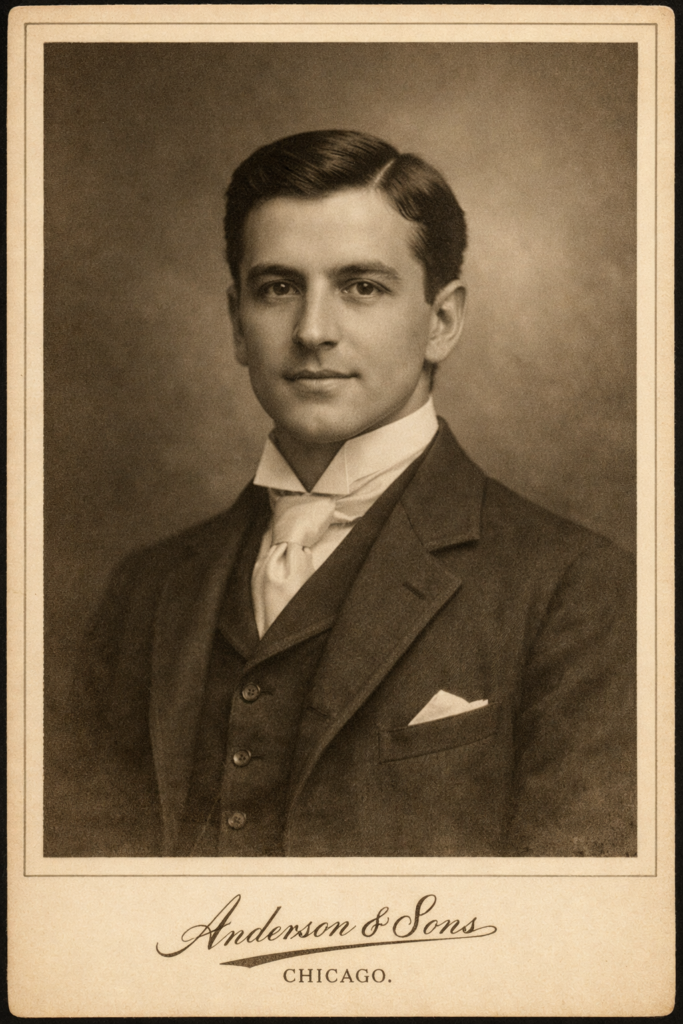
Before he was a legend, before he was a monster, before he was the subject of books and documentaries and true crime podcasts, Herman Webster Mudgett was simply a very smart, very dangerous young man from rural New Hampshire who had figured out something chilling about the world: most people trust far too easily.
Mudgett was born on May 16, 1861, in Gilmanton, New Hampshire. By all accounts he was a brilliant child graduating high school at 16, he enrolled in medical school at the University of Michigan at 18, and displayed a facility for science and anatomy that impressed his professors. He also displayed, from a very young age, a disturbing fascination with death.
As a medical student in Michigan, Mudgett began what would become a lifelong pattern of fraud. He stole cadavers from the university’s anatomy lab, disfigured or burned them to make identification impossible, and then filed fraudulent insurance claims on the bodies, pretending they were accident victims whose lives he had insured. The scheme worked. Mudgett collected the money, graduated, and moved on.
He was already married to Clara Lovering, the daughter of a well-to-do family whose money had helped fund his education. He would abandon her without a word, leaving her to raise their son alone.
By 1885, Herman Webster Mudgett had reinvented himself. His new name was Henry Howard Holmes, reportedly chosen as an homage to the fictional detective Sherlock Holmes in a new city, with new ambitions. He had moved to Chicago.
The Making of the Murder Castle
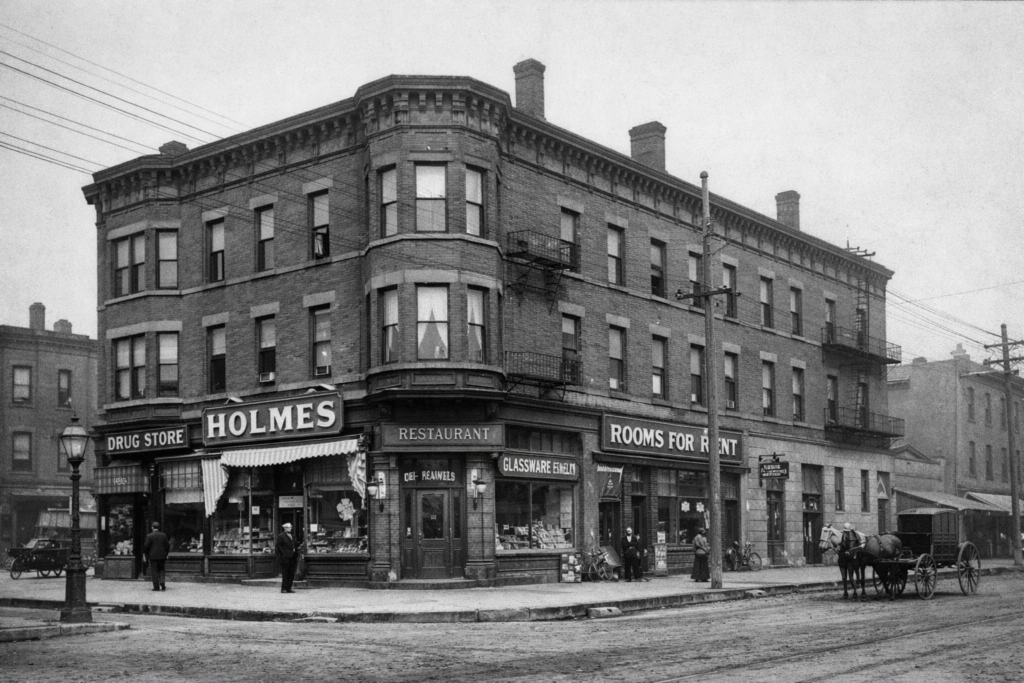
Holmes arrived in Chicago’s Englewood neighborhood in 1885 and immediately set about establishing himself. He took a position at a pharmacy on the corner of 63rd and Wallace Streets, impressing the owner with his medical credentials and his natural charm. Within a few years, through a series of frauds and manipulations too convoluted to fully untangle, he had taken control of the pharmacy entirely.
Then he purchased the empty lot across the street.
Construction on what would become known as the Murder Castle began in 1887. Holmes hired and fired multiple construction crews throughout the process so that no single contractor would ever have a complete picture of what was being built. He refused to pay many of his contractors, claiming their work was substandard and sending them away before they could see the finished product. It was a pattern he would repeat throughout his life: use people until they were no longer useful, then discard them.
The building that emerged was a three-story mixed-use structure: retail shops on the ground floor, apartments on the second, a third story added later when Holmes decided to market the building as a hotel. From the outside, it looked like any other commercial building of the era.
The inside was something else entirely.
What Was Really Inside
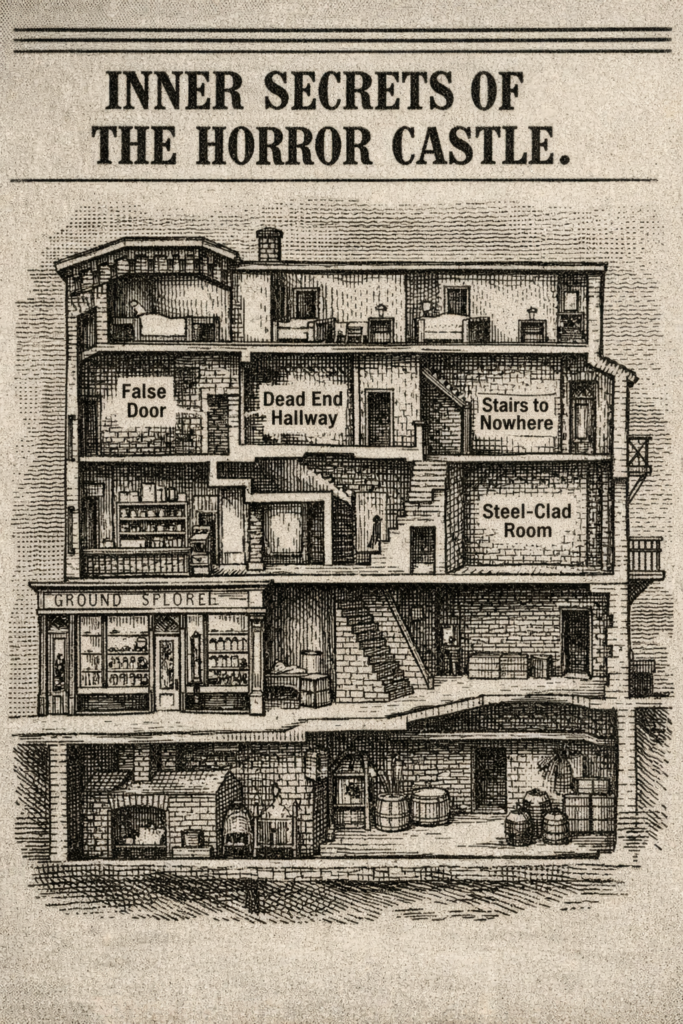
The mythology that has grown up around the Murder Castle over the past century is extravagant and lurid, with gas chambers, trapdoors that dropped victims into the basement, a crematorium, vats of acid, and a torture room equipped with a rack. Much of this, historians now believe, was the product of the yellow journalism that dominated newspapers in the 1890s, where sensationalism sold papers, and facts were optional.
The truth, as documented by historians like Adam Selzer, author of H.H. Holmes: The True History of the White City Devil, is both more mundane and in some ways more disturbing than the legend.
The building did contain hidden rooms and secret passages, but they were not quite the elaborate death maze of popular imagination. The hidden spaces were used primarily to conceal stolen property, to hide Holmes from creditors and fraud investigators who were increasingly on his trail, and in some cases to trap and kill victims when the opportunity arose.
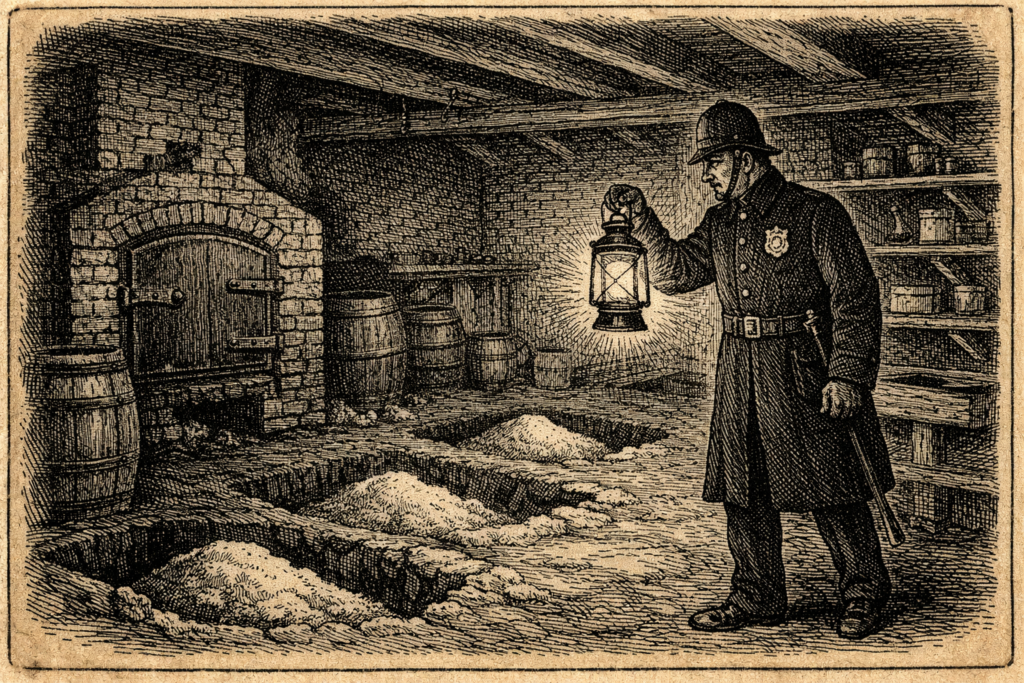
What was definitely real was the basement. When investigators finally searched the building after Holmes’ arrest in 1894, they found a functioning crematorium, pits of quicklime, a substance used to accelerate the decomposition of organic matter, and evidence consistent with the disposal of human remains. The basement was real. What happened in it was real.
What is also real is that Holmes was operating a fraud factory out of the building’s retail spaces, selling goods he never owned, borrowing money he never intended to repay, taking out insurance policies on employees and associates, and then ensuring those policies paid out.
Murder, for Holmes, was often simply the most efficient solution to a business problem.
The World’s Fair and the Hunting Ground
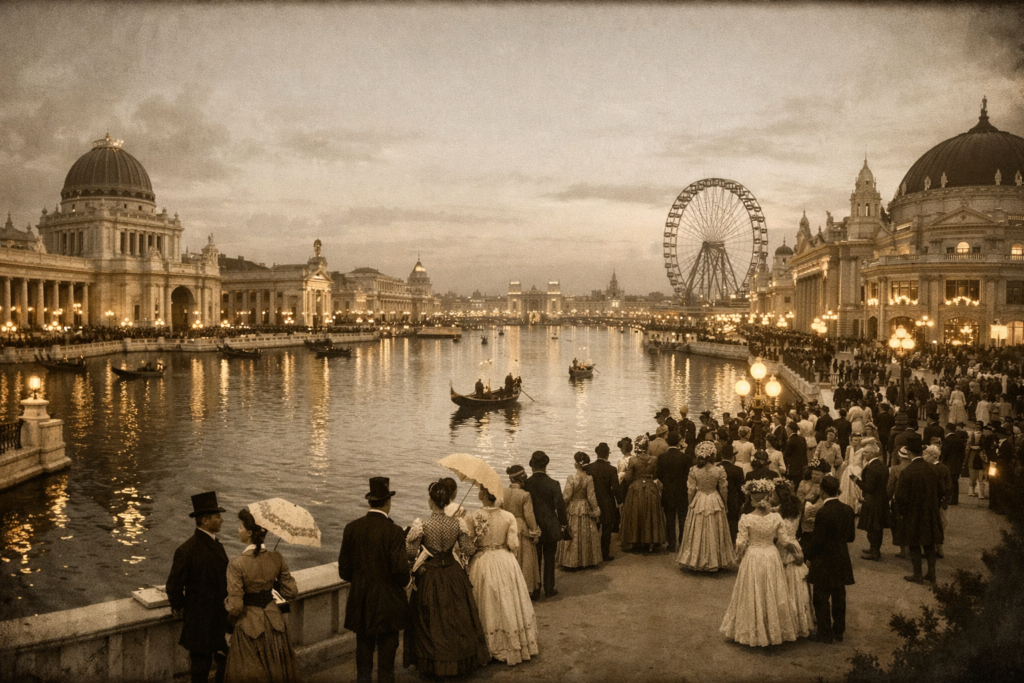
In 1893, Chicago hosted the World’s Columbian Exposition, a massive international exhibition celebrating the 400th anniversary of Columbus’ arrival in the Americas. The fair attracted more than 27 million visitors to the city over six months. It was the largest concentration of temporary wealth and opportunity Chicago had ever seen, and Holmes saw it as exactly that: an opportunity.
He began advertising the upper floors of his building as hotel rooms for fairgoers. He placed classified advertisements in newspapers for young female employees at his various business operations. He was charming, educated, well-dressed, and seemingly respectable. He was the kind of man a young woman newly arrived in the city from a small town might trust.
Many of them never left.
The confirmed victim count for H.H. Holmes is a matter of genuine historical dispute. Holmes himself confessed to 27 murders; several of the people he claimed to have killed were verifiably still alive at the time of his confession, either invented or named to inflate his legend. Careful historical research by Selzer and others has confirmed approximately nine murders with reasonable certainty.
The true number is almost certainly higher than nine and almost certainly lower than the 200 that sensationalist accounts have suggested. The documented victims include Julia Conner and her young daughter Pearl, who worked for Holmes and disappeared; Minnie and Nannie Williams, sisters whom Holmes defrauded and murdered; and three children of his associate Benjamin Pitezel, whom Holmes killed in an attempt to cover up an insurance fraud scheme.
The children’s deaths are among the most disturbing elements of Holmes’ case. Aged roughly seven to fourteen, Howard, Nellie, and Alice Pitezel were in Holmes’ care when they were killed. Holmes had convinced their mother, Carrie Pitezel, that her husband was alive and in hiding, and he was stringing her along in a separate city while he methodically eliminated every witness who could connect him to the insurance fraud that was his primary motive.
The Unraveling
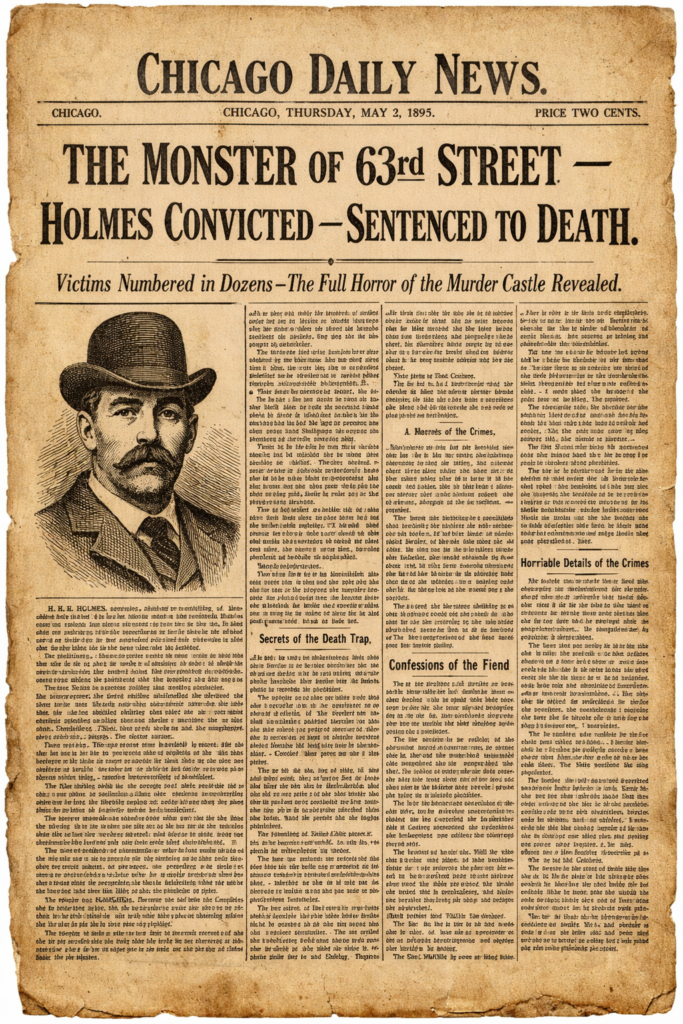
Holmes’ downfall began not with murder but with horses.
By 1894, Holmes was deeply entangled in a Texas horse theft scheme, and the Pinkerton National Detective Agency, a premier private investigation firm of that time, had been tracking him across multiple states for various fraud offenses. When he was arrested in Boston in November 1894, it was initially on a horse theft warrant.
But as investigators began pulling at the threads of Holmes’ history, the scale of what he had done began to emerge. The Pitezel insurance fraud came to light. The bodies of the three Pitezel children were found in Toronto and Indianapolis, where Holmes had killed them in separate incidents to prevent them from revealing his location. The insurance fraud involving Benjamin Pitezel, whom Holmes had killed and then helped his associates falsely identify to collect the life insurance, was documented.
In July 1895, Chicago police and journalists began a thorough investigation of the building at 63rd and Wallace. What they found in the basement with the crematorium, the quicklime, the human fragments all confirmed what investigators had begun to suspect.
Holmes was tried and convicted for the murder of Benjamin Pitezel. He was hanged on May 7, 1896, at Moyamensing Prison in Philadelphia. He was 34 years old.
Before his death, Holmes made a final request: that his coffin be filled with cement and buried under ten feet of earth. He was afraid, he said, of being exhumed and dissected — the very fate he had visited upon so many of his own victims.
His request was granted.
What the Legend Gets Wrong and Why the Truth Is Scarier
The Murder Castle mythology with the gas chambers, trapdoors, and the 200 victims is almost certainly exaggerated. The yellow journalists of the 1890s were not interested in accuracy; they were interested in selling papers, and a monster with a building full of mechanized death traps sold far more papers than a con man who sometimes murdered inconvenient business associates.
But here is the thing about the real H.H. Holmes that is, in its way, more terrifying than the legend: he was not obviously a monster.
He was charming. He was educated. He was handsome. He was the kind of man people trusted instinctively, which is precisely what made him so dangerous. His victims were not strangers grabbed off the street; they were people who knew him, who worked for him, who trusted him. His killing was personal and intimate and motivated primarily by greed.
Holmes killed because it was efficient. A business associate who knew too much became a liability. A woman he had defrauded and no longer needed became a risk. The children of Benjamin Pitezel were simply witnesses who needed to be eliminated. There was almost no passion in it, just calculation.
That cold efficiency is what makes Holmes genuinely frightening to contemplate, even 130 years later. He is not the stuff of gothic horror. He is something quieter and more disturbing: a man who looked at other human beings and saw only obstacles and opportunities.
The Haunted Ground: What Stands There Now
The Murder Castle itself burned in 1895, under circumstances that remain unclear, although most historians believe Holmes arranged the fire, possibly to destroy evidence, possibly as part of yet another insurance fraud scheme. The building was rebuilt and continued to operate in various forms for decades.
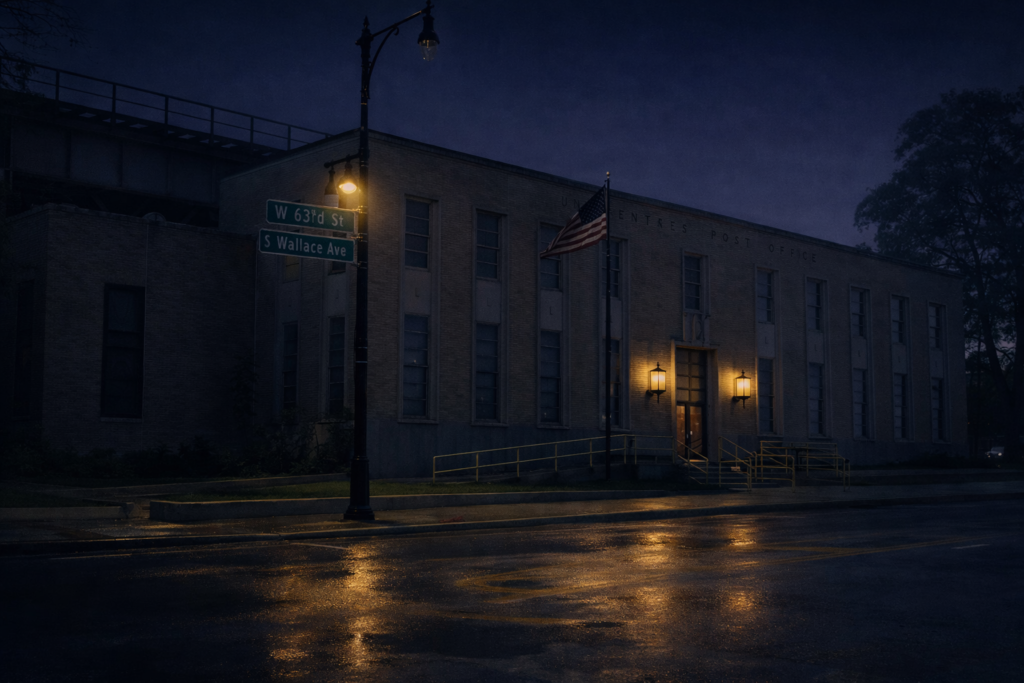
Today, the lot at 63rd and Wallace in Chicago’s Englewood neighborhood is occupied by the Englewood branch of the United States Post Office as well as a parking lot. There is no marker, no monument, no acknowledgment of what happened on this ground.
But the stories have persisted for decades.
Postal workers assigned to the Englewood branch have reported unusual experiences in the building’s basement, which sits on the same ground as Holmes’ original basement crematorium. Unexplained sounds, the sensation of being watched, and equipment malfunctions concentrated in certain areas. The basement, workers have said, feels wrong in a way that is difficult to articulate mostly a persistent, low-level unease that doesn’t correspond to any identifiable source.
Paranormal investigators who have studied the Englewood Post Office site note that the specific characteristics of the reported activity are consistent with what researchers sometimes call residual haunting, which is a kind of psychic imprint left by events of extreme violence or suffering, replaying independently of any conscious intelligence.
Whether you accept that framework or not, the location has an undeniable weight to it. Stand on the corner of 63rd and Wallace in Englewood, listen to the El train rattle overhead, look at the unremarkable post office facade, and try to hold in your mind what happened here in the 1890s. The ordinariness of it is part of what makes it haunting.
Chicago’s Other Holmes Haunted Locations
The Englewood Post Office is not the only Chicago location connected to Holmes and his crimes that carries a reputation for paranormal activity.
Graceland Cemetery on Chicago’s North Side, one of the city’s oldest and most storied burial grounds, was the site of several inquiries into Holmes’ activities. It has an extensive independent paranormal reputation, with reported apparitions dating back well over a century.
The Green Mill Lounge in Uptown, while not directly connected to Holmes, was a significant Prohibition-era haunt with its own documented dark history of violence it is the kind of layered dark history that Chicago’s most persistently haunted locations tend to share.
The Chicago History Museum holds a significant collection of artifacts and documents from the Holmes case, including items recovered from the Murder Castle site. Several staff members over the decades have reported unusual experiences with the Holmes materials, like objects being moved, temperature anomalies, and the persistent feeling of being watched.
Whether these reports reflect genuine paranormal phenomena or simply the psychological weight of proximity to objects connected to extreme violence is a question that each visitor must answer for themselves.
The Legacy of H.H. Holmes
H.H. Holmes entered popular culture in a major way with Erik Larson’s 2003 bestseller The Devil in the White City, which wove Holmes’ story together with the construction of the 1893 World’s Fair. The book introduced millions of readers to a story that had been largely forgotten outside of Chicago true crime circles, and it sparked a wave of renewed interest in Holmes that continues to this day.
The legacy of that renewed interest has been complicated. Holmes has become, in some corners of popular culture, a kind of dark celebrity — his crimes repackaged as entertainment, his name attached to merchandise and escape rooms and ghost tours. There is something uncomfortable about this, given that his victims who trusted him and died for it.
Julia Conner was 24 years old when she disappeared. Her daughter Pearl was seven. Minnie Williams was a Texas heiress who met Holmes in Boston and died in Chicago. Howard Pitezel was eleven. Nellie was ten. Alice was fifteen.
Their names deserve to be remembered alongside his.
Key Facts
- Born: Herman Webster Mudgett, May 16, 1861, Gilmanton, New Hampshire
- Executed: May 7, 1896, Moyamensing Prison, Philadelphia
- The Murder Castle was built at 63rd and Wallace Streets, Englewood, Chicago, between 1887 and 1891
- Confirmed victims: approximately 9, though Holmes confessed to 27
- The building burned in 1895 under suspicious circumstances
- Today the Englewood branch of the US Post Office occupies the site, with a reported paranormal history in its basement
- Holmes was convicted of the murder of Benjamin Pitezel, not for his Chicago crimes
- Holmes was one of the most prolific fraudsters of the 19th century and was subject to more than 50 lawsuits in Chicago alone
Sources & Further Reading
CBS Chicago: “Chicago Hauntings: The Story of H.H. Holmes’ Murder Castle.” July 2025.
Schechter, Harold. Depraved: The Definitive True Story of H.H. Holmes. Pocket Books, 1994.
Library of Congress, Chronicling America: H.H. Holmes newspaper archive, 1894-1896.
Chicago History Museum: Holmes case files and artifacts.
Leave a Reply