
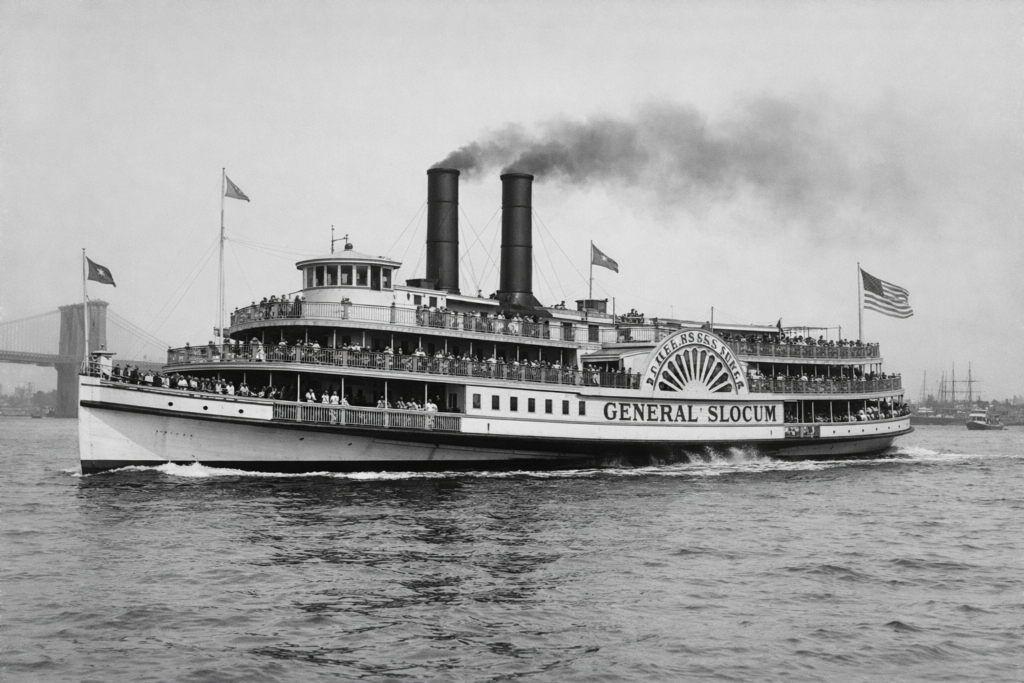
On the morning of June 15, 1904, more than thirteen hundred women and children boarded a steamship at the Third Street pier on the East River. By eleven o’clock, more than a thousand of them were dead. Within a generation, almost no one in New York remembered why.
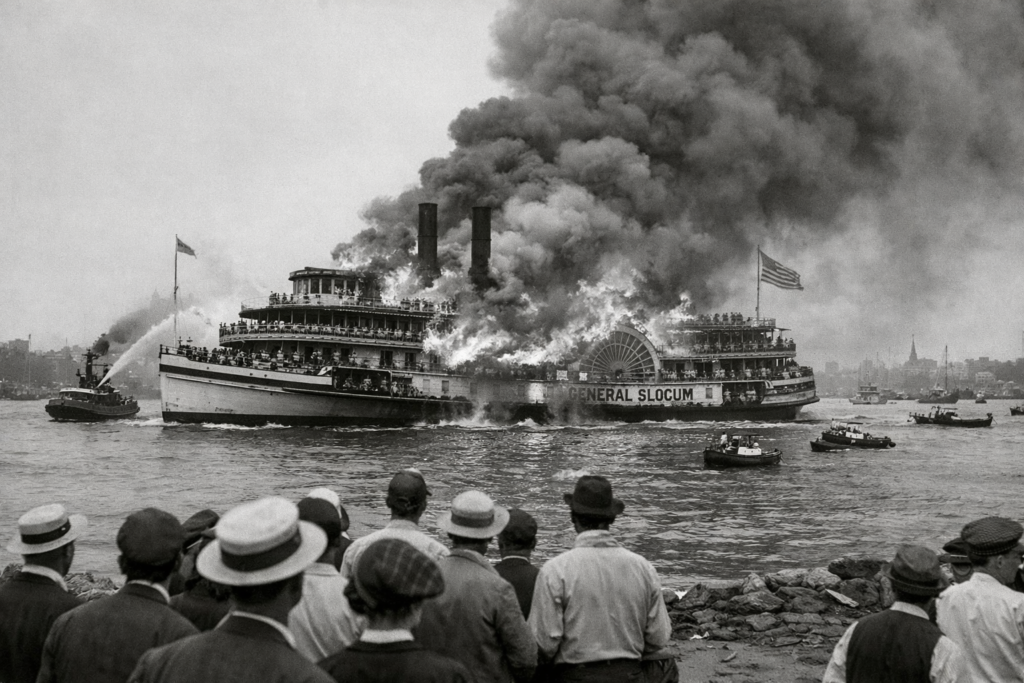
The neighborhood is gone now. So are the people. So is the church that organized the picnic, in the only sense that matters unimaginably, the people who filled its pews on Sundays were drowned, burned, and trampled to death over the course of about forty-five minutes on a clear Wednesday in June, and the building that lost them never recovered them.
This is the story of the General Slocum disaster, one of the worst single-day losses of life in New York City between the Draft Riots of 1863, the attacks of September 11, 2001, and the small German neighborhood on the Lower East Side that vanished with it.
It is not a famous story. It should be.
Kleindeutschland: The City That Spoke German
By 1904, the area roughly bounded by 14th Street, the Bowery, Division Street, and the East River was the third-largest German-speaking community in the world, after Berlin and Vienna. Its residents called it Kleindeutschland or Little Germany. About fifty thousand people lived in it. The street signs were in German. The newspapers were in German. The bakeries, the social clubs, the union halls, the saloons, the Turnvereins, the Lutheran churches, the Catholic churches, and the freethinkers’ beer gardens all conducted their daily business in German, and had since the failed European revolutions of 1848 pushed the first wave of refugees across the Atlantic.
At the heart of it, on East Sixth Street between First and Second Avenues, stood St. Mark’s Evangelical Lutheran Church. Its congregation was almost entirely first- and second-generation German-American. Its pastor, the Reverend George C. F. Haas, had baptized most of the children in the building and married most of their parents.
For seventeen years, St. Mark’s had held an annual Sunday school picnic on the second or third Wednesday of June. The destination was Locust Grove, a picnic ground on the north shore of Long Island, near Eatons Neck. The travel arrangement was the same every year: charter a steamship, board at a pier on the East River, sail north up the river, through the Hell Gate, into Long Island Sound.
In 1904, the church chartered the PS General Slocum, a thirteen-year-old side-wheel paddle steamer owned by the Knickerbocker Steamship Company. The contract price was three hundred and fifty dollars.
It would be the last picnic the congregation ever took.
The Ship
The General Slocum was launched in 1891 from a shipyard in Brooklyn and named for Henry Warner Slocum, the Civil War general and former congressman who had died in 1894. The ship was 235 feet long, drew about eight feet of water, and could carry up to 2,500 passengers across three open wooden decks.
It had a record. It had run aground in 1894. It had collided with a tugboat in 1901. It had run aground a second time the next year. In 1894, panicked passengers had stampeded during a minor mechanical scare and trampled others; the company had quietly settled the resulting suits.
It had been inspected for safety, on paper, five weeks before the picnic. The inspector Henry Lundberg, who would later admit under oath that he had not actually examined the equipment, had certified the ship’s life preservers, fire hoses, and lifeboats as fit for service.
He had certified, in particular, 3,000 cork life preservers stored in racks above the upper deck.
Many of those life preservers were thirteen years old. Cork has a useful life as a flotation device of approximately six years. After that, it begins to crumble into a fine yellow powder. To meet the legal weight requirement of seven pounds, the minimum set by the United States Steamboat Inspection Service to certify a preserver as buoyant, the manufacturer of the Slocum‘s preservers, the Nonpareil Cork Works, had inserted iron bars into a portion of them.
What this means in plain language is that some of the life preservers handed to mothers on June 15, 1904, were not flotation devices. They were anchors.
The ship’s six lifeboats were lashed down with wire and painted into place. The fire hoses, when finally turned on, burst at the seams or could not be coupled to the standpipes. The crew of approximately thirty had never participated in a fire drill.
None of this was secret. All of it was on file with the federal government.
The Morning of June 15
The picnickers began boarding at the Third Street pier shortly before nine in the morning. Most were women. The men of Kleindeutschland were at work in the breweries, the piano factories, the cigar shops, the dockyards. Most of the rest were children. The Reverend Haas brought his own wife and daughter. Many families brought all of their children, the school-aged with the toddlers, the toddlers in the arms of their older sisters.
A small German band, the Professor George Maurer Orchestra, set up on the foredeck and began playing as the ship cast off. The newspapers the next morning would all use the same word for the mood at the moment of departure: fröhlich. Cheerful. The captain that day was William H. Van Schaick. He was sixty-six years old. He had captained the General Slocum for the entire thirteen years of her existence.
The Slocum steamed away from Manhattan at 9:40 AM. By 9:50, she was abreast of East 90th Street, making about fifteen knots in calm water. By 10:00, she was approaching the entrance to the Hell Gate, a violent tidal strait where the East River, the Harlem River, and Long Island Sound meet, named for the Dutch Hellegat, “bright passage,” and remembered by every captain in New York for the wrecks at the bottom of it.
Somewhere below the foredeck, in a windowless storage compartment called the Lamp Room, a fire began.
The Lamp Room
The Lamp Room was a small wooden closet on the forward part of the lower deck. It contained, on the morning of June 15:
- a barrel of straw used to pack glassware
- several gallon cans of lamp oil
- multiple packed lanterns and oil lamps
- a quantity of old, oil-soaked rags
- a few cans of paint left over from the spring repainting
The official cause of ignition was never definitively determined. The most cited theory is a discarded match or carelessly handled cigarette dropped by a deckhand. What is not in dispute is that the fire was discovered by a fourteen-year-old boy, Frank Perditski, who saw smoke coming from under the door, opened it, watched the room flash into flame, and ran to the pilot house to tell the captain.
Captain Van Schaick, by his own later testimony, told the boy to “shut up and mind his own business.”
By the time the second crewman arrived at the pilothouse with the same report, the entire forward portion of the lower deck was on fire. The wind from the ship’s own forward motion was now pushing the fire backward through the vessel at a speed that no fire crew on earth could have outrun.
This is the moment at which Captain Van Schaick made the decision that killed everyone who died that day.
The Decision
The Slocum was, at the moment the fire was confirmed, almost exactly equidistant from three places it could have beached safely.
To the Bronx side were the docks and shoreline near East 134th Street, perhaps eight hundred yards distant. To starboard was the Queens side as well as the Astoria shore, similarly close. Either choice would have run the burning ship aground in waist-deep or chest-deep water within two minutes, allowing passengers to step or swim to safety in shallow water close to the rescue services of a populated city.
Van Schaick chose neither. He chose North Brother Island it was a small island roughly a mile ahead, on which sat a quarantine hospital for contagious diseases. (It is the same island where, three years later, Typhoid Mary would be confined for the rest of her life.) North Brother was farther, the water around it deeper, and the channel to reach it ran directly through the Hell Gate.
Van Schaick maintained, then and for the rest of his life, that he was afraid of beaching at 134th Street because doing so would set fire to the lumberyards and oil tanks lining the Bronx waterfront.
The ship continued forward at full steam.
The forward motion functioned as a bellows. The fire, fed by thirty-five years of dry-rotted wood paint and twenty knots of relative wind, raced from the Lamp Room aft through the lower deck, then up the wooden stairwells to the second deck, then up the second stairwells to the third. Within three minutes of the captain’s decision, the entire forward half of the ship was a single column of fire.
The passengers, almost all of whom were on the upper decks where they could no longer reach the stairs, had two choices.
They could burn alive on the deck.
Or they could jump.
What the Life Preservers Did
The crew of the General Slocum did, in many cases, behave heroically. Crewmen distributed life preservers, tore them from their racks, tied them onto children, and threw them to passengers in the water. They did everything they had been trained to do.
The training was the problem. The preservers were the problem.
When the cork-and-iron life jackets were strapped to small children and the children were thrown overboard, the iron pulled the children directly to the bottom of the East River.
When mothers strapped the preservers to themselves and jumped, the rotten cork crumbled within seconds in the water, and the canvas casings became dead weight. The Hell Gate’s tidal current at that hour was running at approximately five knots, twice the speed of the strongest swimmer alive, and almost no woman in the New York of 1904 had ever been taught to swim.
The recovery records of the New York Police Department are explicit. Of the women and children pulled from the water, the overwhelming majority were already dead, drowned within feet of the surface, the iron weights of their preservers still sewn into the canvas at their chests.
Meanwhile, on the burning decks, women were tying their children’s wrists to their own with strips of clothing so they would not be separated in the water. A great many of the bodies later recovered were still tied together.
The ship beached at North Brother Island at approximately 10:20 AM, by which time virtually everyone aboard was either dead, dying, or in the river. The hospital staff and patients, including some of the typhoid quarantine, ran out into the shallows to pull bodies from the water. They saved a handful of lives. They could not save more than a handful. The official death toll is 1,021. Some historians put the true number above 1,030, accounting for unidentified bodies and presumed missing. More than two-thirds of the dead were children under the age of fifteen.
The Bodies
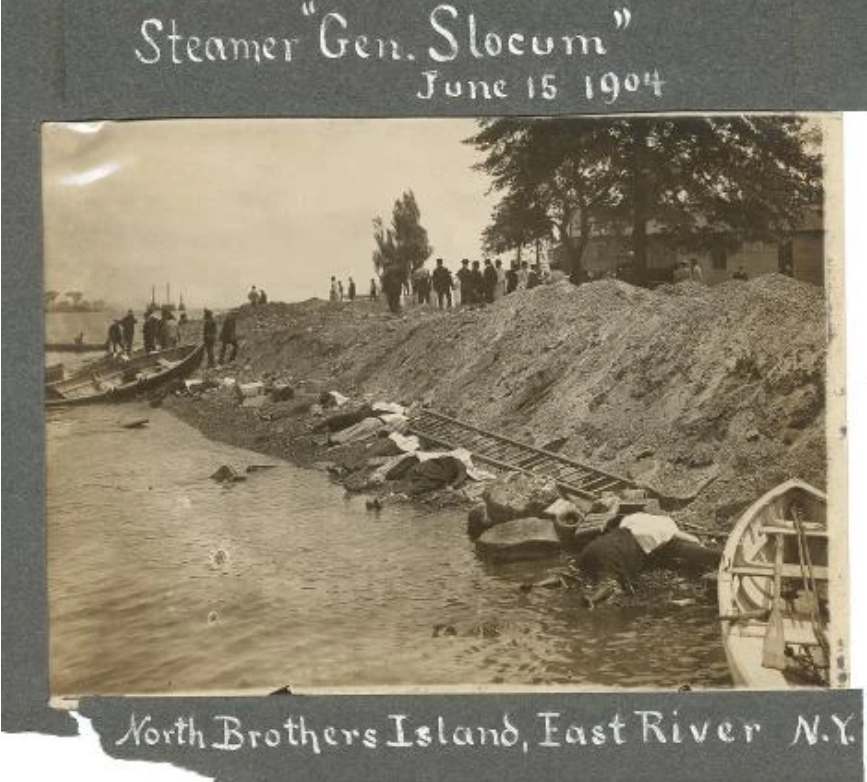
For three days after the fire, the East River and Long Island Sound delivered bodies onto every beach and pier from East 138th Street to Throgs Neck. They came up in the cribbing under the docks. They came up tangled in the propellers of working tugboats. They came up bound to one another by mothers’ aprons and children’s stockings.
The morgue at Bellevue Hospital received more than three hundred bodies in the first twenty-four hours and ran out of space. Auxiliary morgues were established along the East River. The bodies of the unidentified, mostly small children, in particular, whose parents had also died, were photographed, numbered, and laid out in long rows for surviving relatives to walk past.
Most of the dead were buried in Lutheran All Faiths Cemetery in Middle Village, Queens, in the days that followed. The cemetery operators ran funerals on a continuous schedule from sunrise to sunset for nearly a week. Some plots held five or six members of a single family. A few of the unidentified children were buried in a single mass plot under a stone that reads only: Memorial to Those Who Lost Their Lives in the Disaster of the General Slocum.
The Reverend Haas survived. His wife and daughter did not. He preached one final sermon at St. Mark’s. He could not continue. The congregation, what remained of it, dispersed.
The Trial That Was Not a Trial
A federal grand jury indicted seven men in connection with the disaster: Captain Van Schaick; the president and secretary of the Knickerbocker Steamship Company; the federal inspectors who had certified the ship; and the manufacturer of the life preservers.
Of the seven, only Captain Van Schaick was ever convicted of anything.
In January 1906, he was found guilty of criminal negligence, specifically, of failing to maintain proper fire drills and inspect his crew’s emergency equipment. He was sentenced to ten years in Sing Sing. He served three and a half. President William Howard Taft pardoned him on Christmas Day, 1912. Van Schaick lived comfortably until 1927.
The Knickerbocker Steamship Company was assessed a fine that was, in the language of the indictment, “not to exceed the value of the vessel.” The vessel had been valued at salvage. The fine was negligible. No officer or director of the company was ever convicted of anything. The company continued to operate other vessels under different names well into the 1920s.
The federal inspectors were quietly retired or transferred. The manufacturer of the life preservers the Nonpareil Cork Works, was investigated and never charged. The iron bars that drowned the children were ruled to have been a “manufacturing irregularity. “The federal La Follette Seamen’s Act of 1915, sometimes called the Slocum Act, did eventually require Coast Guard-style certified safety drills, real-cork life preservers, and unannounced equipment inspections on passenger vessels in U.S. waters. It came eleven years too late for Kleindeutschland. It is, however, the reason your modern ferry does not burn down.
The Disappearance of a Neighborhood
The morning after the fire, the German-language newspapers of New York published lists of the dead in tight black type running to seven and eight columns per page. The lists ran for days. Some of the families on those lists had been wiped out entirely, every female member of three generations dead in one morning, the surviving fathers and grandfathers returning home to apartments full of empty children’s beds.
Many of those men did not stay.
The collapse of Kleindeutschland in the years after the Slocum disaster has been studied by historians of New York for over a century, and the thesis is now well-established: the neighborhood did not survive its dead. The widowed husbands could not bear to walk past the playgrounds where their daughters had played. The grandmothers could not bear to attend a Lutheran service when half the pews were empty. The neighborhood emptied house by house, as families relocated to Yorkville on the Upper East Side, or to Queens, or to Hoboken, or simply gave up on New York entirely and moved to the German-American settlements of the Midwest.
The First World War finished what the Slocum had started. By 1917, anti-German sentiment in New York had made it dangerous to speak German in public. The German-language street signs were removed. The Turnvereins changed their names. The remaining German social clubs went underground, and most of them never came back.
By 1925, Kleindeutschland did not exist. Many of the buildings remained, and many of them still stand today, in what is now the East Village, but the community that had built them had scattered. The name Little Germany, which had described one of the largest German cities on earth, was no longer used by anyone. The Slocum disaster is the seam at which that community broke.
What Is Still There
If you go looking, several things remain.
Tompkins Square Park, on East Tenth Street, holds the only public memorial to the disaster: a small marble fountain dedicated in 1906 by the Sympathy Society of German Ladies, inscribed with a verse from the Lamentations of Jeremiah and the words They were earth’s purest children, young and fair. Most of the runners and dog-walkers who pass it every day do not know what it commemorates.
St. Mark’s Evangelical Lutheran Church, at 323 East Sixth Street, is no longer a Lutheran church. The building was sold in 1940 to a Ukrainian Orthodox congregation and now serves as St. Nicholas of Myra Orthodox Cathedral. The congregation that survived the Slocum had dwindled to a handful of elderly worshippers by the late 1930s. There were not enough of them left to keep the building.
Lutheran All Faiths Cemetery in Middle Village, Queens still holds the great majority of the Slocum dead. The mass grave for the unidentified, with its dignified gray monument, is still maintained. The individual family plots, many with German inscriptions, are still legible. If you walk the cemetery on a June afternoon, you can still find dates of death reading 15 Juni 1904 in row after row after row.
North Brother Island is now closed to the public. The hospital ruins where the staff and patients pulled bodies from the water are overgrown with vines and inhabited only by herons. From the Bronx waterfront on a clear day, you can still see the island sitting in the river exactly where the Slocum came to rest.
The last survivor, Adella Liebenow Wotherspoon, was six months old on the day of the fire. Her mother and two sisters drowned. Her father, who had been at work, raised her. She lived to be one hundred years old. She died on January 26, 2004 — four months and twenty days before the disaster’s hundredth anniversary, and with her death, the General Slocum became, in the strict sense of the word, history. There is no longer anyone alive who remembers it.
A Closing Note from the Society
The Slocum is the kind of story this Society exists to tell. It is forgotten not because it is unimportant. It is forgotten because the people it killed had no political power. After all, the men responsible were almost entirely shielded from consequence, because the language they spoke became unfashionable, and because the city that lost them found it more convenient to move on.
A thousand and twenty-one people died in forty-five minutes within sight of the Bronx shoreline because a captain made a bad decision, an inspector signed a paper he had not read, and a manufacturer sewed iron into a child’s life vest to meet a weight specification.
This is what it means to say: real history, real places, real dark.
The fountain is still in Tompkins Square Park. The names are still in the cemetery. The river is still there.
You can go.
Sources & Further Reading
- O’Donnell, Edward T. Ship Ablaze: The Tragedy of the Steamboat General Slocum. Broadway Books, 2003.
- United States Department of Commerce and Labor, Report of the United States Commission of Investigation upon the Disaster to the Steamer “General Slocum” (Government Printing Office, 1904).
- The New-York Historical Society, General Slocum Disaster Collection (manuscript and photographic holdings).
- The New York Times archive, June 15 – July 15, 1904.
- Lutheran All Faiths Cemetery records, Middle Village, Queens.
Staats-Zeitung and New Yorker Volkszeitung (German-language press coverage, June 1904).
Leave a Reply