Every haunted place has a history. Sometimes that history is so dark, so deliberately buried, that the echoes of what happened there never fully go away. This is one of those stories.
They Knew It Would Kill People. They Did It Anyway.
It is one of the most disturbing chapters in American history, a story of government-sanctioned mass murder carried out not by a foreign enemy or a rogue official, but by the United States federal government itself, acting in broad daylight, with full knowledge of what it was doing.
During Prohibition, from 1920 to 1933, the US government ordered the deliberate poisoning of industrial alcohol with lethal chemicals. They knew Americans were drinking it. They knew people would die. They did it anyway.
The death toll from what historians now call the “chemicalization” program has been estimated at anywhere from 10,000 to 50,000 Americans. Most were poor. Most were working class. Most had no idea what hit them.
And almost none of them are remembered today.
How Prohibition Created a Poisoning Problem
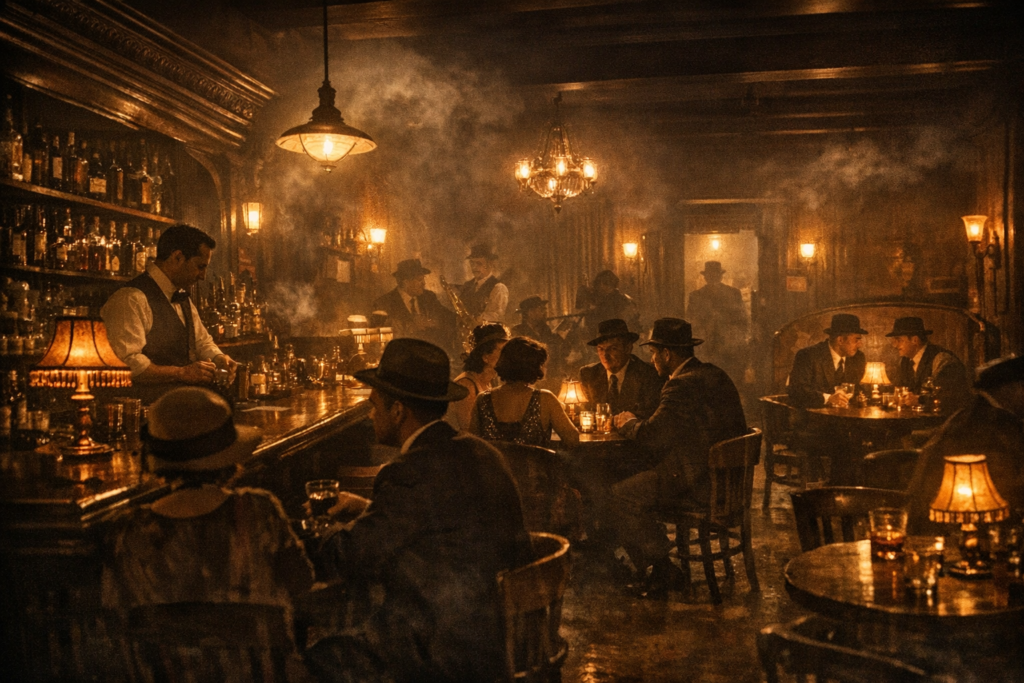
When the 18th Amendment took effect on January 17, 1920, it didn’t eliminate alcohol; it just made legal alcohol disappear. What replaced it was a vast underground economy of bootleggers, speakeasies, and home distillers who supplied a thirsty nation.
The problem was supply. Bootleggers needed alcohol, and the easiest source was industrial alcohol, the kind used in manufacturing, cleaning products, and fuel. It was never meant for human consumption, but it was widely available and cheap.
The government knew this was happening almost immediately. By the early 1920s, federal agents were well aware that bootleggers were “re-naturing” industrial alcohol, redistilling it to remove the chemicals used to make it undrinkable and then selling it as liquor.
So the government changed the formula.
Starting in 1926, under pressure from the Anti-Saloon League and Prohibition enforcement officials, the Treasury Department ordered manufacturers of industrial alcohol to add increasingly deadly chemicals to their products. The goal was simple: make the alcohol so toxic that even skilled bootleggers couldn’t remove the poison.
What followed was one of the most calculated acts of violence ever perpetrated by the American government against its own citizens.
The Poison Cocktail
The original formula for denatured industrial alcohol, alcohol rendered undrinkable by law, included relatively mild additives like methanol and kerosene. Unpleasant, but survivable in small amounts.
The new formula was something else entirely.
By the mid-1920s, the government’s mandated formula included:
- Methanol (wood alcohol) — causes blindness and death even in small quantities
- Gasoline — added to make the taste unbearable
- Benzene — a known carcinogen
- Cadmium — a heavy metal toxic to the kidneys and liver
- Chloroform — a powerful anesthetic and liver toxin
- Camphor — causes seizures in high doses
- Acetone — damages the liver and kidneys
- Quinine — causes severe cardiac events in high doses
Some formulas contained as many as 70 different toxic additives. The most dangerous was always methanol, which the government required in concentrations of up to 10 percent, enough to kill or permanently blind anyone who drank it.
The chemists hired by bootleggers were good, but they weren’t good enough. The new formulas were designed specifically to be impossible to fully remove through redistillation. What came out the other side of a bootlegger’s still was still laced with enough poison to do serious damage.
And the government knew this. They had the toxicology reports. They had the death counts. They kept going.
The Deaths Begin
The poisoning program’s effects appeared almost immediately in New York City’s Bellevue Hospital, where doctors began reporting a sharp spike in alcohol-related deaths and blindness cases starting in late 1926.
By New Year’s Eve 1926 alone, 23 people had died in New York City from poisoned liquor. Hundreds more were admitted to hospitals across the city, many of them blind, many of them experiencing the terrifying symptom cascade that methanol poisoning produces: first a period of apparent recovery, then sudden and catastrophic deterioration.
Methanol poisoning is particularly cruel in how it works. Unlike ethanol, regular drinking alcohol, methanol is metabolized by the body into formaldehyde and formic acid. These compounds attack the optic nerve first, causing sudden, permanent blindness, and then shut down the respiratory system. Victims who drank poisoned liquor on a Saturday night might feel fine Sunday morning, only to go blind by Monday and be dead by Wednesday.
Dr. Charles Norris, the chief medical examiner of New York City, was one of the first officials to publicly condemn what the government was doing. He called the poisoning program “our national experiment in extermination” and published detailed reports connecting the rising death toll directly to the government’s chemicalization policy.
His colleague, toxicologist Alexander Gettler, conducted hundreds of autopsies on poisoning victims and published his findings widely. Both men were largely ignored by the federal government and attacked by Prohibition supporters who argued that the victims had brought their deaths upon themselves.
The official position of the federal government was essentially this: if you drink illegal liquor, you deserve what you get.
“The Chemist’s War”
Journalist Deborah Blum, whose 2010 book The Poisoner’s Handbook brought renewed attention to this chapter of history, has described the government’s Prohibition-era poisoning program as a kind of undeclared chemical war on the American public.
The program was not a secret. It was debated openly in Congress, covered extensively by newspapers, and defended publicly by Prohibition officials. Wayne Wheeler, the powerful head of the Anti-Saloon League and one of the chief architects of Prohibition policy, was particularly blunt about his position.
When critics accused the government of killing innocent people, Wheeler’s response was chilling: the deaths were the fault of the bootleggers who sold the poisoned liquor, not the government that mandated the poison. Anyone who drank illegal alcohol, he argued, was a criminal who had forfeited their right to protection.
This argument was made publicly, repeatedly, and without apparent shame.
Senator James Reed of Missouri was one of the few legislators who pushed back. On the Senate floor, he called the policy “legalized murder” and demanded that the government stop deliberately poisoning its own citizens. He was largely shouted down.
By 1927, New York City’s medical examiner’s office estimated that the poisoning program was killing approximately 1,200 people per year in New York alone. Nationally, the true death toll will never be known with certainty; record-keeping was inconsistent, many deaths were attributed to “alcoholism” rather than poisoning, and the federal government had little interest in tracking a problem it had intentionally created.
Conservative modern estimates put the total death toll from the chemicalization program at somewhere between 10,000 and 15,000. Some historians believe the true number could be two to three times higher.
The People Who Died
It is easy, in the retelling of dark history, to focus on the policy and the politics and lose sight of the people. The victims of the government’s poisoning program were not abstractions. They were real people with names and faces and families.
They were factory workers in New York who drank homemade gin at Christmas parties. They were farmers in the South who kept a flask of bootleg whiskey for cold mornings. They were immigrants in Chicago who gathered in basements and passed around bottles of something that smelled like liquor and tasted like paint thinner, but was all they could afford.
They were poor. Overwhelmingly, the victims of the government’s poisoning program were working class and poor, because wealthy Americans could afford to buy expensive, properly made bootleg liquor from high-end operations that had the resources to at least partially decontaminate their product. The bathtub gin that killed you cost fifteen cents a bottle.
They died in hospital wards, on factory floors, in tenement apartments, on the streets. They went blind on Sundays and were buried by Thursday. They were mourned by their families and forgotten by their government.
The Haunted Aftermath
The locations associated with the deadliest poisoning incidents of the Prohibition era have a long history of reported paranormal activity, a fact that becomes harder to dismiss when you understand the scale of suffering that took place in them.
Bellevue Hospital in New York, which received hundreds of poisoning victims during the worst years of the program, has been one of the most consistently reported haunted locations in the city for nearly a century. Staff and patients have reported apparitions, unexplained sounds, and the sensation of unseen presences in the older sections of the building, the same wards where poisoning victims were brought in by the dozens during the late 1920s.
Several of the speakeasies and underground bars that inadvertently served poisoned liquor during Prohibition are now reported haunted locations. Pete’s Tavern in New York, one of the oldest continuously operating bars in the city, has a long history of reported paranormal activity. The Green Mill in Chicago, a notorious Prohibition-era speakeasy with documented connections to Al Capone, is frequently listed among Chicago’s most haunted locations.
Whether you believe in the paranormal or not, there is something deeply fitting about the idea that these places where people gathered for warmth and fellowship and a drink and instead found death might carry some echo of what happened within their walls.
Prohibition Ends, But the Policy Is Never Punished
When Prohibition ended in December 1933 with the ratification of the 21st Amendment, the government’s poisoning program ended with it. No one was ever prosecuted. No official was ever held accountable. No compensation was ever paid to the families of victims.
The chemicalization program was simply folded into history, briefly acknowledged, quickly forgotten, and never taught in schools.
It would be decades before historians began to piece together the full scope of what had happened. The academic literature on the subject remained sparse until the early 2000s, when researchers like Deborah Blum began publishing work that drew wider public attention to the story.
Even today, most Americans have no idea that their government once deliberately poisoned the alcohol supply and killed thousands of people in the process. It is the kind of history that is deeply uncomfortable to sit with because it forces a confrontation with what governments are capable of doing when they decide that the people they serve are expendable.
Why This Story Matters
The deliberate poisoning of the American alcohol supply during Prohibition is not just a historical curiosity. It is a case study in what happens when government policy dehumanizes the people it is supposed to protect.
The officials who mandated the poisoning formula were not monsters in the conventional sense. They were bureaucrats and reformers and true believers who had convinced themselves that the ends justified the means, that if poisoning the liquor supply scared enough people away from drinking, it was worth the bodies.
They were wrong. And the fact that they were never held accountable for being wrong is part of why this story matters.
The victims of the government’s Prohibition-era poisoning program deserved better than they got. They deserved accurate reporting on what killed them. They deserved accountability from the officials who ordered their deaths. They deserved to be remembered.
This is one small attempt at that remembrance.
Key Facts
- The US government’s industrial alcohol poisoning program ran from approximately 1926 to 1933
- The mandatory poisoning formula included methanol, gasoline, benzene, cadmium, chloroform, and up to 70 other toxic additives
- Estimated deaths range from 10,000 to 50,000 Americans
- The program was publicly known and publicly defended by Prohibition officials at the time
- No one was ever prosecuted or held accountable when Prohibition ended
- The story received little mainstream historical attention until the early 2000s
- Bellevue Hospital in New York, which treated hundreds of poisoning victims, remains one of New York City’s most persistently reported haunted locations
Sources & Further Reading
- Blum, Deborah. The Poisoner’s Handbook: Murder and the Birth of Forensic Medicine in Jazz Age New York. Penguin Press, 2010.
- Okrent, Daniel. Last Call: The Rise and Fall of Prohibition. Scribner, 2010.
- Norris, Charles. Medical Examiner’s Reports, City of New York, 1926-1928. (New York City Municipal Archives)
- Gettler, Alexander O. Toxicological Reports, Bellevue Hospital, 1926-1930.
- US Treasury Department. Regulations Relating to Denatured Alcohol. Government Printing Office, 1927.
If this story disturbed you — good. Dark history should disturb us. It’s the only way we make sure it doesn’t repeat.
Explore more forgotten stories of American dark history right here at Haunted Homestead Society.
Leave a Reply