The Complete Beginner’s Guide to Ghost Hunting (2026 Edition)
Where dark history and haunted places meet
Introduction: Why Ghost Hunting Is Surging in 2026
Ghost hunting isn’t a fringe hobby anymore. In 2026, it’s a cultural phenomenon fueled by social media, paranormal tourism, and a growing desire to understand what happens after death. But behind the viral clips and TV dramatizations lies a much older tradition: the human instinct to document, investigate, and make sense of the unexplained.
This guide is designed for beginners who want to approach ghost hunting with respect, accuracy, and historical awareness, certainly not theatrics. Whether you’re planning your first investigation or simply curious about the tools and techniques, this is a comprehensive, grounded, and up‑to‑date beginner’s guide.
This isn’t about chasing shadows. It’s about understanding the history, the environment, and the human stories behind haunted places.
Real history. Real places. Real dark.
What Ghost Hunting Actually Is — And What It Isn’t
Ghost hunting is the practice of investigating locations where people have reported unexplained activity. Most serious investigators aren’t “hunting” anything! They’re documenting, observing, and recording.
Ghost hunting is:
- A structured investigation of environmental anomalies
- A way to preserve oral history and folklore
- A method of documenting unexplained experiences
- A blend of science, psychology, and historical research
Ghost hunting is not:
- Demon chasing or constant provocation
- Screaming in the dark for entertainment
- Blindly trusting every noise or shadow
The best investigators approach haunted locations the way a historian approaches an archive: with curiosity, skepticism, and respect.
Understanding Types of Hauntings
Before you step into the field, it helps to understand the two major categories of hauntings that investigators often discuss.
Residual Hauntings
A residual haunting is often described as a kind of recording. We understand it as an emotional imprint left behind by trauma, repetition, or intense energy.
- No interaction with investigators
- Repeats the same sounds or visuals
- Often tied to violent or emotional events
- Not intelligent or aware
Residual hauntings are history echoing through time.
Intelligent Hauntings
An intelligent haunting appears to respond to investigators in real time.
- Direct responses to questions
- Movement or manipulation of objects
- Audible voices or knocks
- Changes in EMF or temperature that correlate with interaction
Intelligent hauntings are rarer and more controversial, which is why careful documentation is crucial.
The Equipment Every Beginner Needs (and What You Don’t)
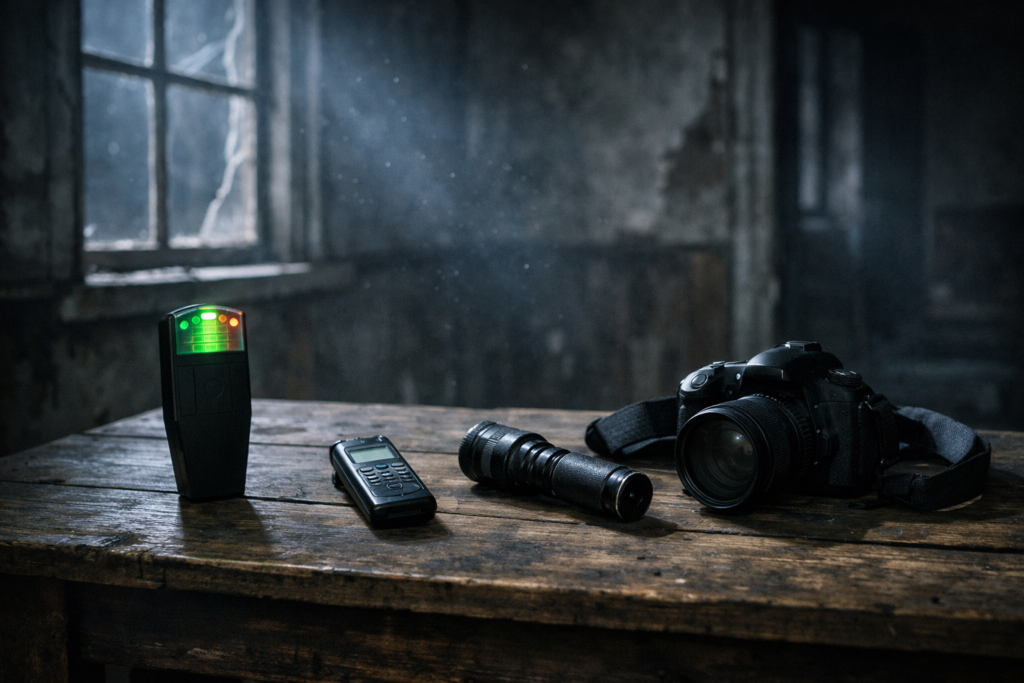
You don’t need a suitcase full of gadgets to start ghost hunting. A few reliable tools and the knowledge to use them correctly will take you much further than a pile of flashy gear.
Essential Beginner Equipment
1. Digital Voice Recorder
What it does: Captures audio for EVP (Electronic Voice Phenomena) sessions.
Why investigators use it: EVPs are one of the most commonly reported forms of potential paranormal evidence.
How to use it:
- Record in short sessions (5–10 minutes)
- Announce all noises (“That was my foot,” “Car outside”)
- Review with quality headphones
Common mistake: Interpreting static, breathing, or the rustle of clothing as voices.
2. EMF Meter
What it does: Measures electromagnetic fields.
Why investigators use it: Some theories suggest unexplained EMF spikes may correlate with paranormal activity.
How to use it:
- Take baseline readings before starting
- Identify all electrical sources (wiring, outlets, appliances)
- Look for sudden, localized spikes rather than constant high readings
Common mistake: Standing next to a breaker box or outlet and assuming the readings are paranormal.
3. Flashlight
What it does: Illuminates dark spaces and keeps you safe.
Why investigators use it: Safety is non‑negotiable in old, unfamiliar buildings.
Common mistake: Using the “flashlight trick” (loosening the bulb so it flickers). That’s not paranormal just a loose connection.
4. Camera
What it does: Documents the environment visually.
Why investigators use it: Photos and video help verify claims and debunk false positives.
How to use it:
- Take photos in bursts of three
- Avoid shooting directly into bright light sources
- Keep the lens clean to reduce false “orbs.”
Common mistake: Calling dust, insects, or moisture “orbs.”
5. Notebook or Digital Log
What it does: Tracks time, events, and environmental changes.
Why investigators use it: Documentation is the backbone of a credible investigation. Without notes, evidence loses context.
Optional Beginner Tools
- Spirit Box: Rapid radio sweep device used for real‑time audio responses. Highly prone to false positives; use cautiously.
- Thermal Camera: Shows temperature variations, useful for identifying drafts, leaks, or environmental anomalies.
- REM‑Pod: Detects changes in the electromagnetic field around the device, best used in controlled environments.
Tools to Avoid as a Beginner
- Phone apps: Most “ghost hunting apps” are entertainment only.
- Word‑generating devices: Ovilus‑style tools are unreliable and easily influenced by random noise.
- Anything promising guaranteed spirit contact: No device can guarantee paranormal communication.
How to Choose Your First Investigation Location
Not all haunted locations are beginner‑friendly. Some require permits, some are unsafe, and some are emotionally heavy. Choosing the right first location sets the tone for your entire experience.
Start With Public, Historically Documented Locations
Good beginner options include:
- Old cemeteries
- Historic battlefields
- Public parks with known tragedies
- Town squares or historic districts with documented events
These locations are generally accessible, safer, and rich in history.
Avoid Private Homes at First
Investigating someone’s home requires experience, emotional sensitivity, and an understanding of psychological factors. Beginners should not take on private residential cases.
Research the History First
Before you visit, take time to:
- Read local historical society materials
- Check newspaper archives
- Look for documented tragedies or notable events
- Understand the cultural and social context of the location
The more you know, the more meaningful and focused your investigation will be.
Check for Legal Restrictions
Some locations require:
- Permits or reservations
- After‑hours access agreements
- Liability waivers
Never trespass. Trespassing is the fastest way to end a ghost hunting career, or worse, possibly get arrested.
How to Conduct a Ghost Hunt: Step‑by‑Step
This is a basic framework used by many serious investigators. You can adapt it as you gain experience, but the core principles stay the same.
Step 1: Establish a Baseline
Before you start any “active” investigation, walk the location and:
- Note EMF readings in different areas
- Identify drafts, creaks, and natural sounds
- Locate hazards like loose floorboards or low ceilings
- Observe how sound travels through the building
Baseline data helps you distinguish normal from potentially anomalous later.
Step 2: Decide on Lighting
“Lights out” is popular on TV, but it’s not required. In fact:
- Your senses work better with some light
- Cameras often perform better with ambient light
- Safety improves dramatically when you can see
Use darkness only when it serves a specific purpose, not just because it looks spooky.
Step 3: EVP Session
EVP sessions are a staple of ghost hunting. To run one:
- Sit quietly and minimize movement
- Ask simple, respectful questions one at a time
- Wait 10–15 seconds between questions to allow for responses
- Announce any noises you make during the session
Examples of questions:
- “Is anyone here with us?”
- “Can you tell us your name?”
- “Do you remember what happened here?”
Step 4: EMF Sweep
Walk slowly through the location with your EMF meter and:
- Compare readings to your baseline
- Note any sudden spikes in areas without obvious electrical sources
- Document the time, location, and conditions when spikes occur
Step 5: Environmental Logging
Record environmental conditions such as:
- Temperature and humidity
- Weather conditions
- Time of day
- Moon phase (if relevant to your approach)
Environmental factors can influence both human perception and equipment behavior.
Step 6: Controlled Experiments
Set up simple, controlled tests, such as:
- Placing a REM‑Pod in a doorway and leaving it undisturbed
- Setting a camera on a tripod to watch a specific area
- Leaving a recorder in an empty room while you investigate elsewhere
The key is to change one variable at a time so you can interpret results more clearly.
Step 7: Debrief Immediately After
Once the investigation ends, sit down with your team and:
- Discuss what each person experienced
- Compare notes and timelines
- Flag moments that felt significant for later review
Memory fades quickly; documenting impressions right away preserves valuable context.
The Science Behind Haunted Experiences
Not every haunting is paranormal and not every experience is easily explained either. Understanding basic scientific and psychological factors helps you avoid mislabeling natural phenomena as supernatural.
Infrasound
Low‑frequency sound waves (below 20 Hz) can cause:
- Nausea and dizziness
- Anxiety or a sense of dread
- Visual distortions at the edge of vision
Many “haunted” buildings have natural or mechanical sources of infrasound.
Electromagnetic Fields
High EMF exposure can cause:
- Headaches
- Tingling sensations
- Feelings of being watched
- Occasional visual or auditory disturbances
Old wiring, transformers, and appliances are common sources.
Carbon Monoxide
Carbon monoxide exposure can lead to:
- Auditory hallucinations
- Visual hallucinations
- Confusion and paranoia
Always prioritize safety and be aware of potential environmental hazards.
Architectural Acoustics
Old buildings can create strange sound behavior:
- Echoes that sound like whispers
- Footsteps that seem to come from nowhere
- Voices traveling through vents or pipes
Sleep Deprivation
Late‑night investigations are common, but fatigue can:
- Distort perception
- Increase suggestibility
- Make ordinary events feel more intense or sinister
What to Do With Your Evidence
After an investigation, you’ll likely have audio, video, photos, and notes. How you handle them determines how credible your work will be.
Review Audio Carefully
- Use quality headphones
- Listen for voices, whispers, or unexplained sounds
- Mark timestamps for anything unusual
Review Video Slowly
- Watch for movement, shadows, or light anomalies
- Compare suspicious moments to known light sources or reflections
Compare Notes With Teammates
Look for overlapping experiences and patterns:
- Did multiple people experience something at the same time?
- Do notes line up with audio or EMF spikes?
Debunk First
Before calling anything “evidence,” ask:
- Could this be environmental?
- Could this be mechanical?
- Could this be psychological?
Debunking doesn’t ruin the fun; it strengthens your credibility.
Share Responsibly
If you post evidence online:
- Provide context (location, conditions, equipment)
- Avoid sensational titles or claims
- Respect the location’s history and the people connected to it
Beginner Mistakes to Avoid
- Provoking: Shouting at or insulting “spirits” is disrespectful and unnecessary.
- Investigating alone: Always bring at least one partner for safety and verification.
- Ignoring safety: Old buildings can be structurally unsound; watch your footing and surroundings.
- Over‑interpreting: Not every noise, shadow, or feeling is paranormal.
- Trespassing: Never enter a location without permission.
Beginner‑Friendly Haunted Locations by Region
These are examples of public, historically documented places that are often accessible for first‑time investigators. Always verify current rules and access requirements.
Northeast
- Gettysburg, Pennsylvania (battlefield and town)
- Fort William Henry, New York
- Salem, Massachusetts (historic district and cemeteries)
South
- St. Augustine, Florida (historic fort and old town)
- Myrtles Plantation, Louisiana (tours only)
- Savannah, Georgia (historic squares and cemeteries)
Midwest
- Villisca Axe Murder House, Iowa (booked tours)
- Mackinac Island, Michigan
- Alton, Illinois (multiple historic sites)
West
- Jerome, Arizona
- Virginia City, Nevada
- Bodie, California (preserved ghost town)
Why Ghost Hunting Matters
Ghost hunting isn’t just about chasing thrills. At its best, it’s about preserving the stories of people who lived through trauma, tragedy, and hardship. It’s about understanding the emotional weight of a place and the history that shaped it.
When done respectfully, ghost hunting becomes a form of historical stewardship. You’re not just documenting the unexplained; you’re honoring the past.
Leave a Reply